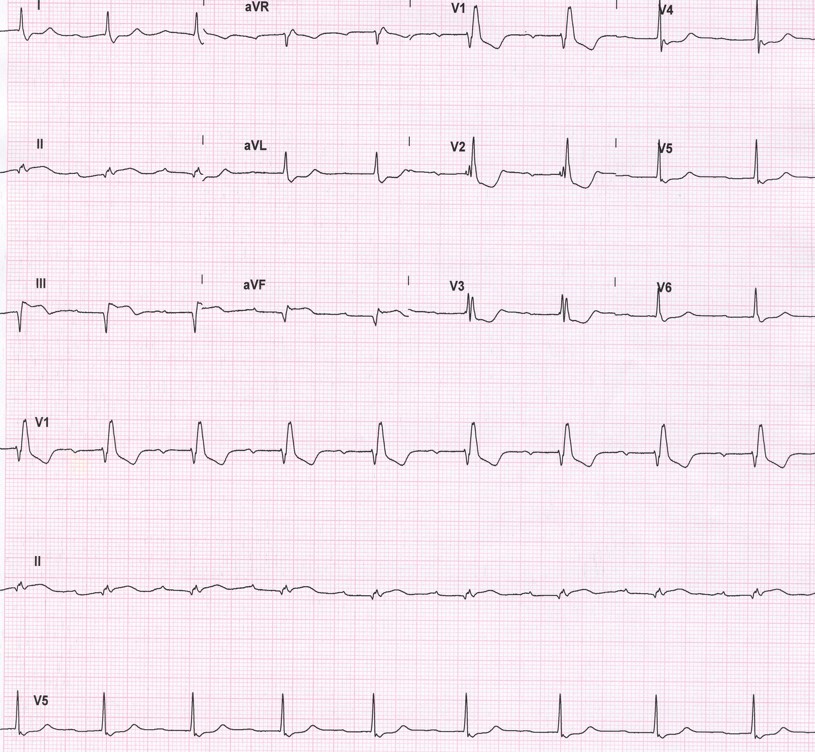
You meet this patient in the waiting hall. You haven't had the chance to procure his history or even ask him his name. What's your diagnosis:
Please answer in the comment section below according to the following format:
Name: Group: Course:
Answer for ECG must follow the following format:
1. What do you see in the ECG?
2. What is your interpretation?
Example of answer:
1. Rhythm sinus, Axis normal, QRS duration is 80ms, No ST elevation.
2. Normal ECG.
Answer for Spot Diagnosis:
The first entry with the correct answers and a correctly-filled form will be picked as the winner. Entries must be sent before 10 a.m. on the 2ndofMay 2010.
The winner for the MSA Academic Quiz - Week 1 is...
Drum roll, please...
CHONG KOK HUNG from Group 37, 6th year.
Congratulations, Chong Kok Hung on your winning entry. Your prize will be passed to you by an MSA Committee representative.
Other entries were as follows:
Entry #1
Answer for ECG:
Irregular rhythm. Sinus rhythm.
Heart rate = 60-70bpm
Normal cariac axis - QRS complex is upright in I and aVF, RII>RI>RIII.
RBBB - M pattern in III, aVF, V2. It is due to the occlusion of LAD supply.
Concordance T-inversion in I, V1-4. Biphasic T-wave ---> Anterior NSTEMI, mainly due to occlusion of LAD
Progressive T-inversion in II.
Pointed P-wave in II, III, aVF; no P-wave in I; P-inversion in aVL - possibility of ectopic right atrial focus. Atrial pacemaker having 75bpm
Answer for Spot Diagnosis:
Alcoholic liver disease
Bruises due to:
1. Frequent falling
2. Hemorrhagic syndrome due to reduce of coagulation factor synthesis from liver ( factor I, II, VII, IX, X)
Red bleb = Spider naevi due to reduce of oestrogen metabolism. Oestrogen acts as vasodilators. Note that spider naevi only found above umbilicus
the ecg shows irregularly irregular patern with p before qrs complexs.
spot dx = hemorrahgic teleangictasis@spider neavi
the man probably suffer from alcoholic liver dz complicated with liver cirrosis, hepatic encepalopathy ( freq fall), hypoproteinamia n coagulation fx (bruises). should look for palmar erethema, jaundice, flaping tremor, ascites n other liver sign n portal hypertension.
Entry #3
ECG:sinus rhythm rate 75/min
normal cardiac axis
second degree heart block,2 p wave perQRS
complex,
right bundle branch block pattern,
ST elevation by 2mm in V1,V2-anterior MI
spot diagnosis:spider angiomata(nevus araneus, spider nevus, vascular spider, and "Spider telangiectasia)
Entry #4
ECG: rhythm: irregular
pace maker: SA node (p wave present)
heart rate : 75 beats per min
P-Q interval : 0.12 sec
QRS complex : 0.1 sec
time of internal deflection
Right ventricle : 0.02 sec
left venbtricle : 0.06 sec
p wave : P pulmnonale ( II, III , AVF)
QRS complex : normal
T wave : biphasic
diagnose: Right atrial hypertrophy
Spot diagnosis: spider naevi , in possibly alcoholic liver cirrhosis
Entry #5
Answer for ECG:
Heart Rate: 75
Rhythm: Sinus rhythm
Diagnoisis: Lateral non-elevated S-T segment Myocardial Infarction with Left Bundle Branch Block
Answer for Spot Diagnosis: Nervus Araneus (Spider Nevus)
A spider nevus consists of a central arteriole with radiating thin-walled vessels. Compression of the central vessel produces blanching and temporarily obliterates the lesion. When released, the threadlike vessels quickly refill with blood from the central arteriole. The ascending central arteriole resembles a spider's body, and the radiating fine vessels resemble multiple spider legs. Spider nevus is often found in young adults.
Rapid development of numerous prominent spider angiomas may occur in patients with hepatic cirrhosis, malignant liver disease, and other hepatic dysfunctions due to the elevated level of estrogen hormone.
The patient admits drinking a lot for the pass years suggests a liver disease in this case with the development of this sign.
Entry #6
ECG- Burgada Syndrome
with normal heart rate, sinus
pathological board QRS complex 0.16s
(suspect bundle branch block)
and rsR' /m in lead II,III, aVL, aVF, V1 & V2
and deep wide S in V5, V6
(suspect RBBB)
but RBBB alone, should have ST iso-line,
there is ST Elevation.
(check hemiblock & bifasicularblock; suspect MI)
To check hemiblock or bifasicularblock,
look at lead I, II, III, there is normal axis R2>R1>R3 , not axis deviation thus exclude it.
To check MI by using Sgarbossa Criteria,
all terminal deflection are discordant to T wave,thus is not myocardia infarction (MI).
STE especially in V1-3
is typical sign for Burgada syndrome.
Spot diagnosis- spider navei
patient is chronic alcohol abuse, cause hepatic disease or mostly end with alcoholic cirrhosis.
Spider navei is most common sign of cirrhosis
and it typically localised in upper part of body.
Pathogenesis- Hepatic disease with impaired hepatic function to detoxify estogen in blood, causing high estrogen in blood, and induce nitric oxide synthase in vasoendothelium and increased nitric oxide which lead to vasodilatation.
The answer scheme for this week's quiz can be downloaded here.
Thank you for all your submissions. There's still more prizes to be won each week. Each week's questions will be posted on 12 a.m. sharp every Monday. Try your luck!
The 2010 Volgograd Futsal League's fixtures, as well as the list of participants have been made available by the organizers. You can download both here.
A 32 years old man has been admitted to a general medical ward. He has been falling a lot and admits to drinking heavily over the years. He is covered in bruises and it’s noticable that there are red blebs on his face, neck, upper chest. What’s your spot diagnosis?
Please answer in the comment section below according to the following format:
Name:
Group:
Course:
Answer for ECG:
Answer for Spot Diagnosis:
The first entry with the correct answers and a correctly-filled form will be picked as the winner. Entries must be sent before 10 a.m. on the 25thofApril 2010.
On the 20th of April 2010, Tuesday, Volgograd State Medical University will be having its Open Day. A ceremony for this event will be held in the Aktovii Zal of the Main Campus at 12.30 p.m. on the same day. Attendance is compulsory for students studying in the pre-medical faculty, first, second, third and fourth courses; and those who are involved in the event.
Lectures for fifth year students will still be held as normal.